
Zero began as an empty space on a counting board and slowly became a number with its own rules. This post follows its journey from Babylon and the Maya to India, Baghdad and Europe, and explains why we still can't divide by it.
Imagine a shopkeeper in a bustling old market, standing before a counting board divided into three columns: ones on the right, tens in the middle, and hundreds on the left.
He places three pebbles in the hundreds column, leaves the tens column empty, and sets five pebbles in the ones column.
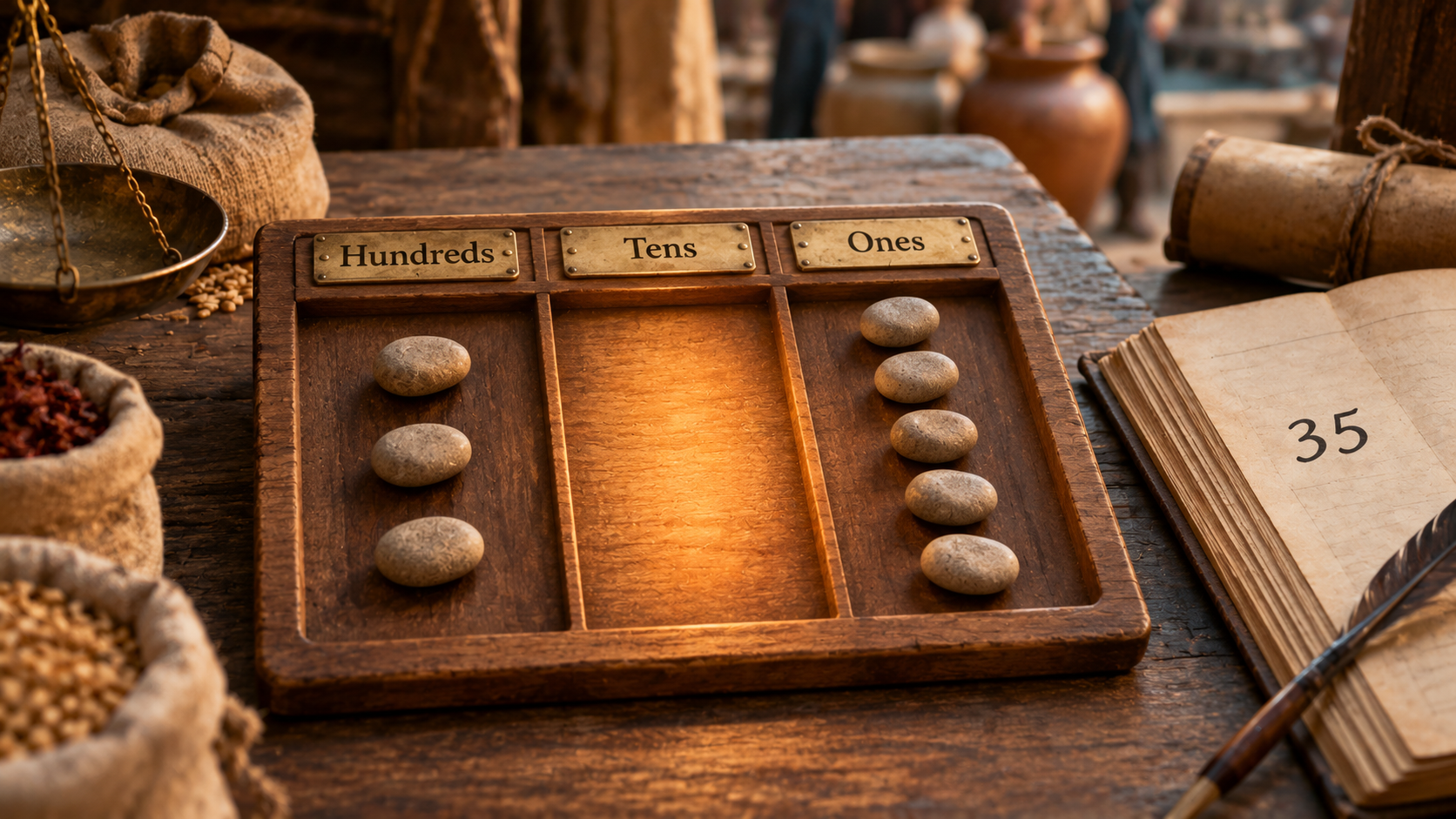
At the end of the day, he records the total in his ledger—a book traders use to keep accounts. He writes a 3 and a 5, but “35” does not reflect what is on his board. The empty column, which should mark the absence of tens, has vanished from the written number.
How can you show that a column is empty? For most of history, people had no clear way to write “nothing is here.” This post follows how that simple problem—marking emptiness—eventually led to the concept of zero as a number. Keep the counting board in mind; we’ll return to it soon.
Life before zero#
Early people counted only what they could see: three sheep, seven days, twelve bags of grain. If a pen held no sheep, they simply called it empty—there was no need for a number to represent “nothing.” In this way, “nothing” was acknowledged, but not counted.
Roman numerals illustrate this well. XXX stands for thirty, with each symbol always representing the same value—an X is always ten, regardless of its position. Because Roman numerals don’t use place value, there was no need to indicate empty columns in written numbers. Calculations were done on a counting board, and only the final answer was written down.
Our modern number system is different: it uses place value. Here, the value of each digit depends on its position. In 305, the 3 means three hundreds because of its place, while the 0 keeps the tens spot open. Without zero, 305 would be written as 35 and lose its meaning entirely.
Try this. Write "two thousand and seven" using only the digits 2 and 7, and leave a gap where the zeros go. Show it to a friend and ask what number they see. You will feel the problem the old scribes felt.
Zero as an empty space#
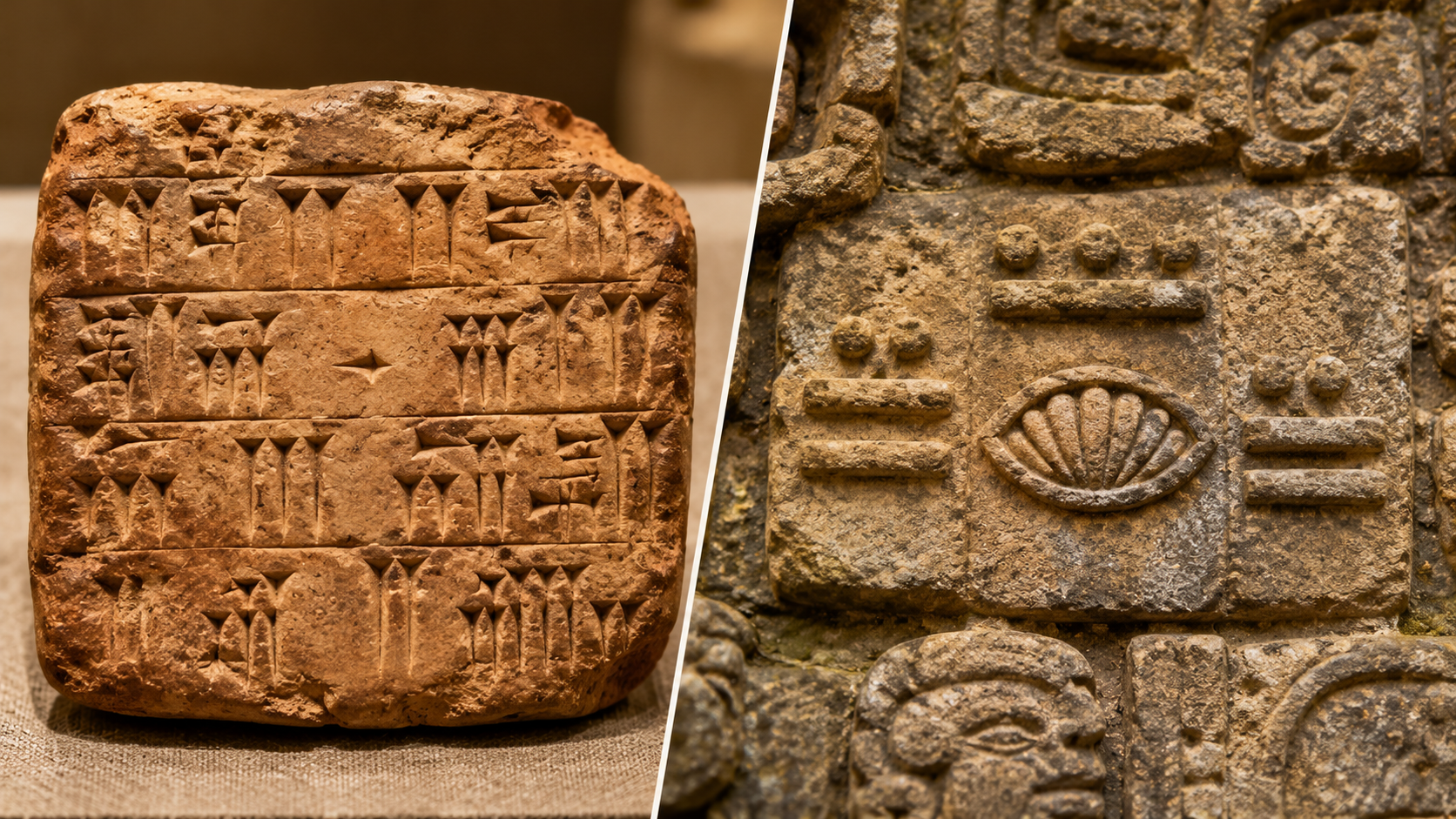
Some civilisations solved the problem in their own ways. The Babylonians—who lived in what is now Iraq—wrote numbers on clay tablets using wedge-shaped marks. They counted in base 60, meaning each new column began after sixty steps. (By comparison, we use base 10.) This base 60 system is often linked to why we have 60 minutes in an hour.
At first, Babylonian scribes simply left a gap to show an empty column, but such gaps were easy to overlook. Eventually, they began using a special mark as a placeholder. Historians date this change to the last few centuries BCE, though the exact timing is uncertain.
Meanwhile, far away in Central America, the Maya counted in base 20. They invented a shell-shaped symbol to represent zero, especially in their calendar system. Scholars generally agree the Maya developed this idea independently.
A placeholder is a mark that says "this column is empty." It is a sign, like punctuation for numbers. A placeholder is not yet a number. Nobody adds it, subtracts it, or asks what it is.
That is the key difference. A placeholder keeps the columns in order. A true number can be used in sums, and it can be the answer to a question. Treating zero that way was the big leap.
Zero as a number: India's contribution#
The story of zero as a number leads strongly to India. But it needs care, because the honest story is more interesting than a simple "India invented zero."
You may read that one person in India "invented" zero at one moment. That is a half-truth. Placeholder zeros appeared in more than one civilization. India's special step was to treat zero as a number with rules. That step took place over a long time and involved many people whose names we do not know.
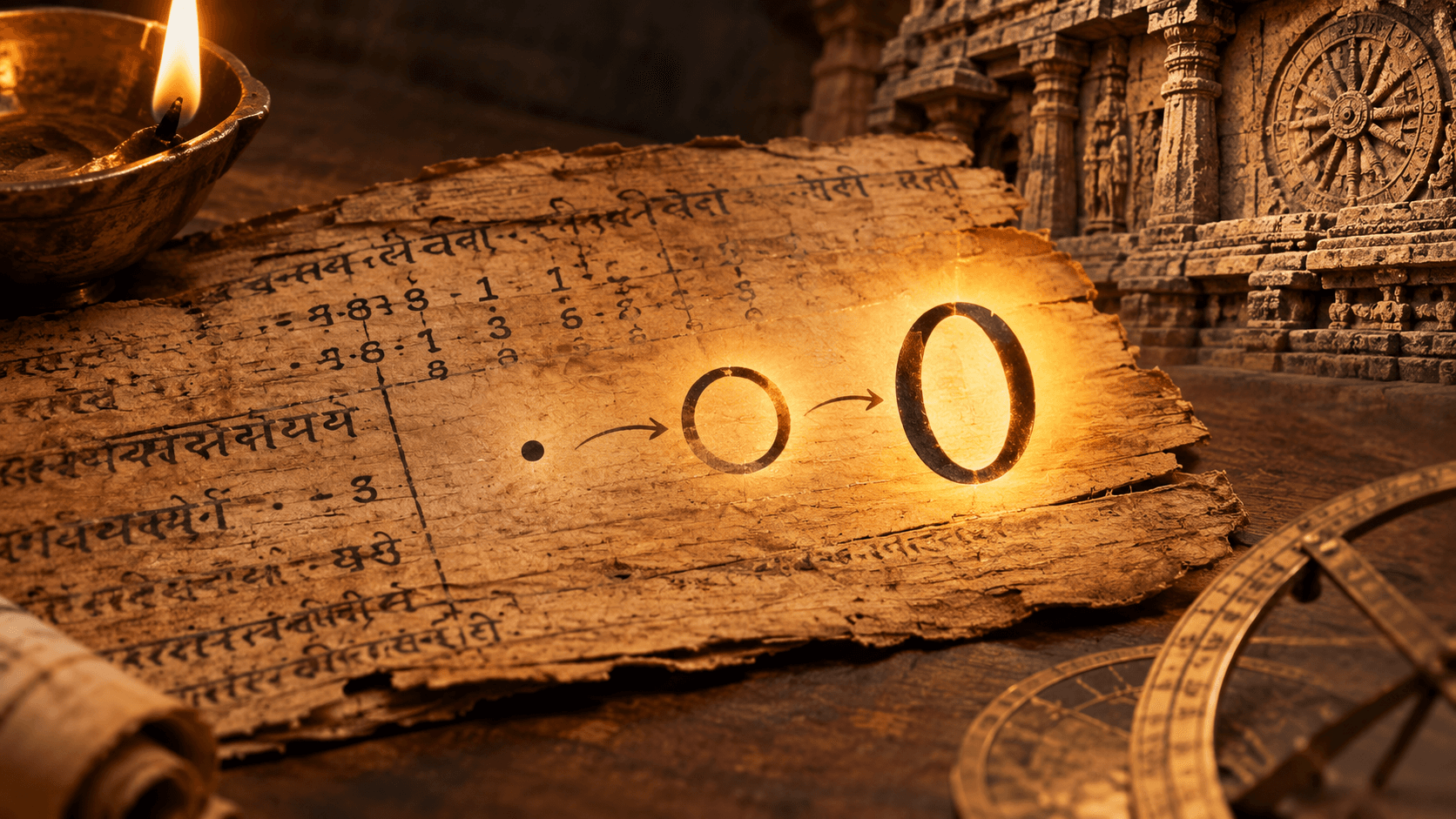
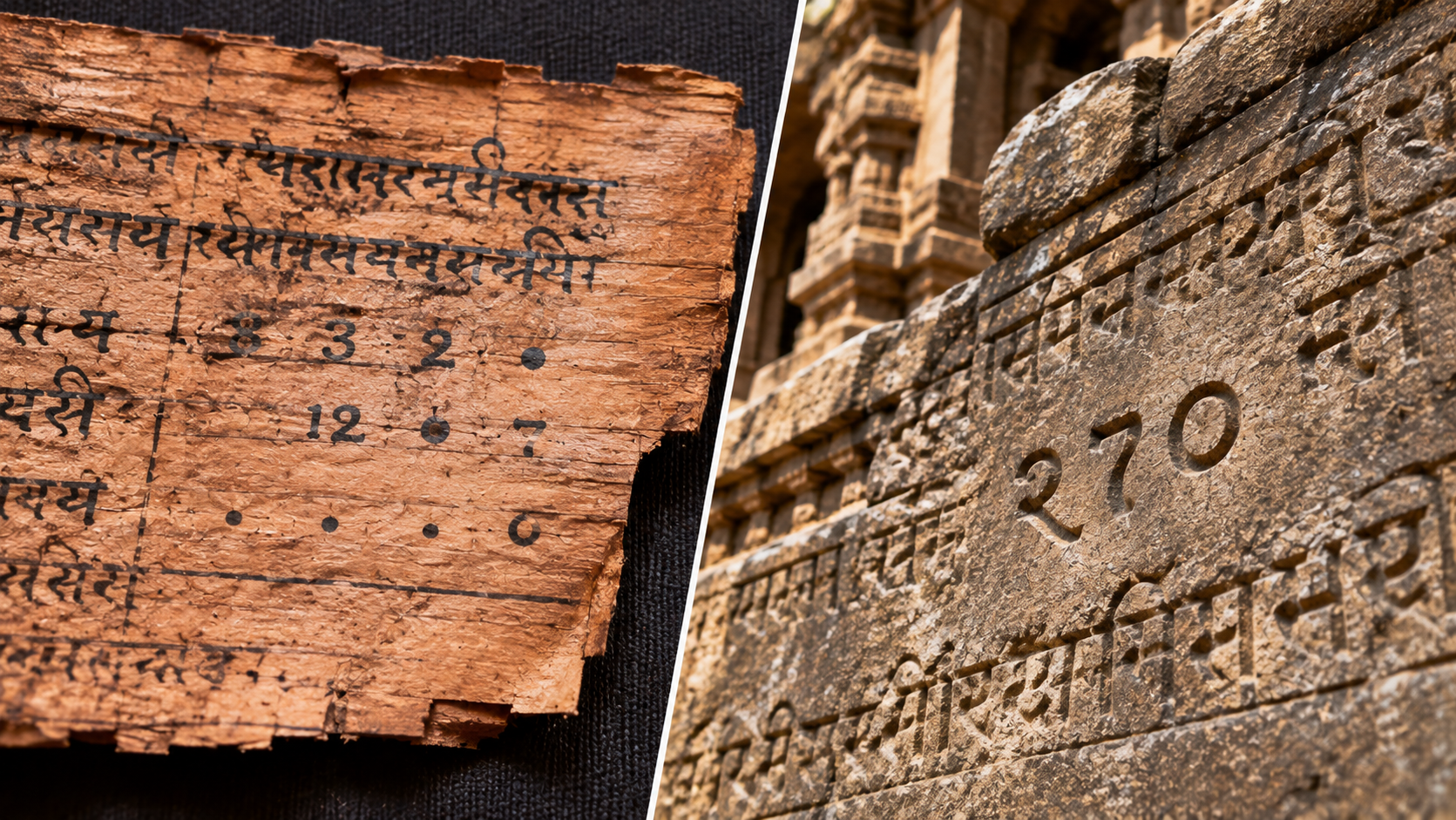
The Bakhshali manuscript. In 1881, a farmer found a bundle of old pages in the village of Bakhshali, in what is now Pakistan. They are written on birch bark, a thin tree bark used like paper. The pages hold maths problems, and they use a dot as a placeholder zero.
How old is it? That is disputed. In 2017, Oxford researchers used radiocarbon dating on three pages. This method measures the age of the material. The results came out centuries apart: roughly the 3rd to 4th, the 7th to 8th, and the 9th to 10th centuries CE. Radiocarbon dating tells us when the bark grew. It does not tell us when the maths was first written. Scholars still argue about what the results mean. So treat any single date for this manuscript as uncertain.
Brahmagupta's rules. In 628 CE, the Indian astronomer Brahmagupta wrote a book called the Brahmasphutasiddhanta. It is one of the earliest surviving texts to lay out rules for zero as a number. In modern words, his rules include these:
A number plus zero stays the same.
A number minus itself is zero.
Any number times zero is zero.
He also worked with "fortunes" and "debts" for positive and negative numbers. He even tried to say what happens when you divide by zero. His answer did not hold up, and later mathematicians had to rethink it. More on that soon.
Now go back to the counting board. Put five pebbles on it, then take all five away. What is left?
Here is the aha moment. Zero is not only a mark for an empty column. It is an answer. When you ask "how many are left?" and the answer is none, that answer is a number. It is called zero.
The Gwalior inscription. An inscription is writing carved into stone. A temple wall in Gwalior, India, carries one dated to 876 CE. It records gifts of land and flower garlands, and it writes numbers such as 270 with a small circle for the zero. It is often cited as one of the oldest securely dated examples of zero in a form we would recognise today.
The Sanskrit word for this idea was "sunya", meaning empty.
The long road to Europe#
Indian number ideas travelled west. In the 9th century, scholars in Baghdad studied them closely. One was al-Khwarizmi, a mathematician who worked there. Around 825 CE, he wrote about calculating with Indian numerals. The Arabic original is lost, but a Latin version survives. His name even gave us the word "algorithm," which means a set of clear steps for solving a problem.
Arabic speakers called zero sifr, which also means "empty." That word is the root of our word "cipher," and the path to "zero" ran through Italian.
In 1202, an Italian merchant's son named Leonardo of Pisa, known as Fibonacci, published Liber Abaci. He had learned this number system in North Africa. His book taught Europeans how to calculate with the nine Indian digits and the sign for zero.
You might expect Europe to cheer. It did not. For centuries, many Europeans kept to Roman numerals and counting boards. They knew those well, and they trusted them. Some feared fraud. A 0 is easy to turn into a 6 or a 9, and it is easy to add extra zeros to a figure. A story often told says that Florence banned the new numerals in business records in 1299. Some thinkers also felt uneasy about treating "nothing" as "something." Historians still discuss how much each reason mattered. What is clear is that acceptance was slow and uneven.

Why you cannot divide by zero#
Division is a sharing question. Share 6 sweets among 3 friends. Each gets 2. We can also check the answer: 2 × 3 = 6.
Now try 6 ÷ 0. We are asking: what number times 0 gives 6? But any number times 0 is 0. Nothing works. There is no answer.
What about 0 ÷ 0? We ask: what number times 0 gives 0? Every number works, so we cannot pick one. The question has no single answer.
Never treat division by zero as an ordinary calculation. It is not "very big" or "equal to zero." It is undefined, which means it has no meaning in normal arithmetic. Hidden division by zero is how many fake "proofs" that 1 = 2 are built.
Why zero matters today#
Zero sits quietly inside nearly everything we do.
Place value. With just ten symbols, 0 to 9, we can write any number, however huge. That works only because zero holds empty places open.
Negative numbers. Zero is the dividing line between positive and negative. Think of a thermometer or a bank balance. Once people accepted zero and "debts," the family of numbers kept growing. If you enjoy where that road leads, read our post on Complex Numbers: Definitions, Geometry, and Key Theorems.
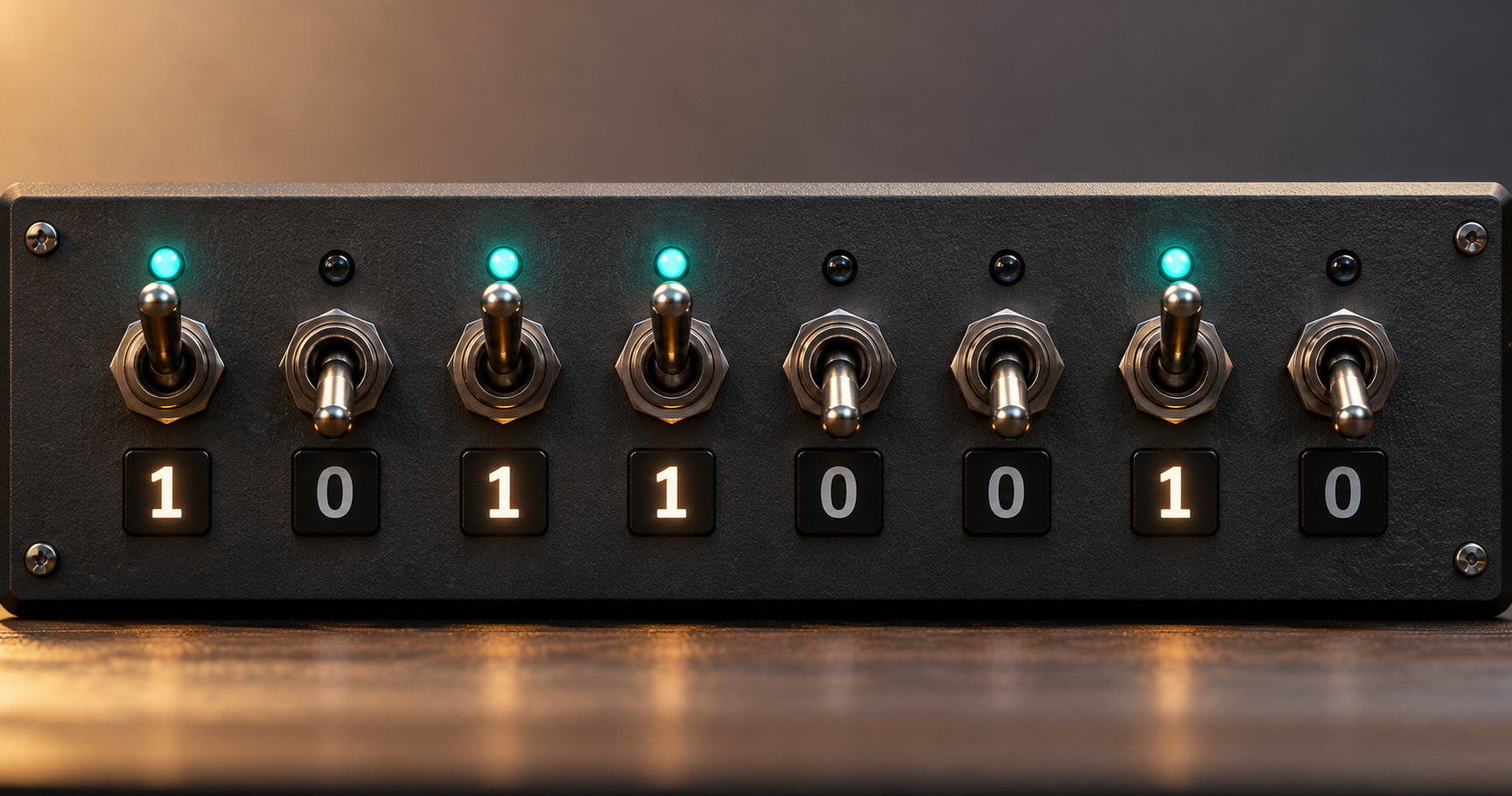
Computers. Computers use binary, a system with only two digits, 0 and 1. Think of tiny switches that are off or on. A photo, a song and this page are all long strings of 0s and 1s. The "off" state matters as much as "on." Computers hide this detail behind many layers, an idea explored in Abstraction: The Most Fundamental Idea in Computer Science.
Zero is also a good example of why maths feels so powerful. A small idea, once understood, opens many doors. We write more about that in Why Mathematics Is the Language of Nature.
Key takeaways#
Before zero, people counted things they could see. "Nothing" did not need a number.
A placeholder zero marks an empty column. A number zero can be added, subtracted and used as an answer.
Placeholder zeros appeared in more than one civilization, including Babylon and the Maya.
India is where zero was treated as a number with rules, as in Brahmagupta's work in 628 CE. Dates for sources like the Bakhshali manuscript are still debated.
Division by zero is undefined, and zero now underlies place value, negative numbers and binary.
A question to think about: What else do we still treat as "just nothing" that might one day turn out to be a useful tool?