

You glance at a clock, read the right time, and still might not know it. Follow a stopped clock through two thousand years of philosophy to see what it really takes to know something.
You glance at the clock on the wall. It says 3:15, so you decide it’s 3:15. And it is 3:15.
You know the time. Obviously.
Now add one detail: the clock stopped working some time ago, and you happened to look at it at one of the two moments each day when its frozen hands are correct. Your belief is the same, and it’s still true. Yet something feels wrong. You got it right by luck. Did you know?
That small discomfort is the doorway to epistemology, the branch of philosophy that studies knowledge: what it is, how we get it, and where it runs out. We’ll keep that clock on the wall for the rest of this post.
[IMAGE: A wall clock frozen at 3:15 in warm afternoon light, with a person’s silhouette glancing up at it from a desk. Soft, editorial illustration, muted palette of cream, teal and amber. No readable text.]
The classic answer: justified true belief#
Let’s start with an old idea. In the dialogue Theaetetus, Plato has Socrates and a young mathematician try to work out what knowledge is. They test a simple answer first (knowledge is just true belief) and find it too weak. They then try adding an “account,” meaning some explanation or reason. The dialogue ends without a settled answer, which is typical of Plato.
In another dialogue, the Meno, Plato offers a memorable picture: true beliefs are like statues that wander off unless they’re tied down. Knowledge is a true belief that has been tied down with reasoning.
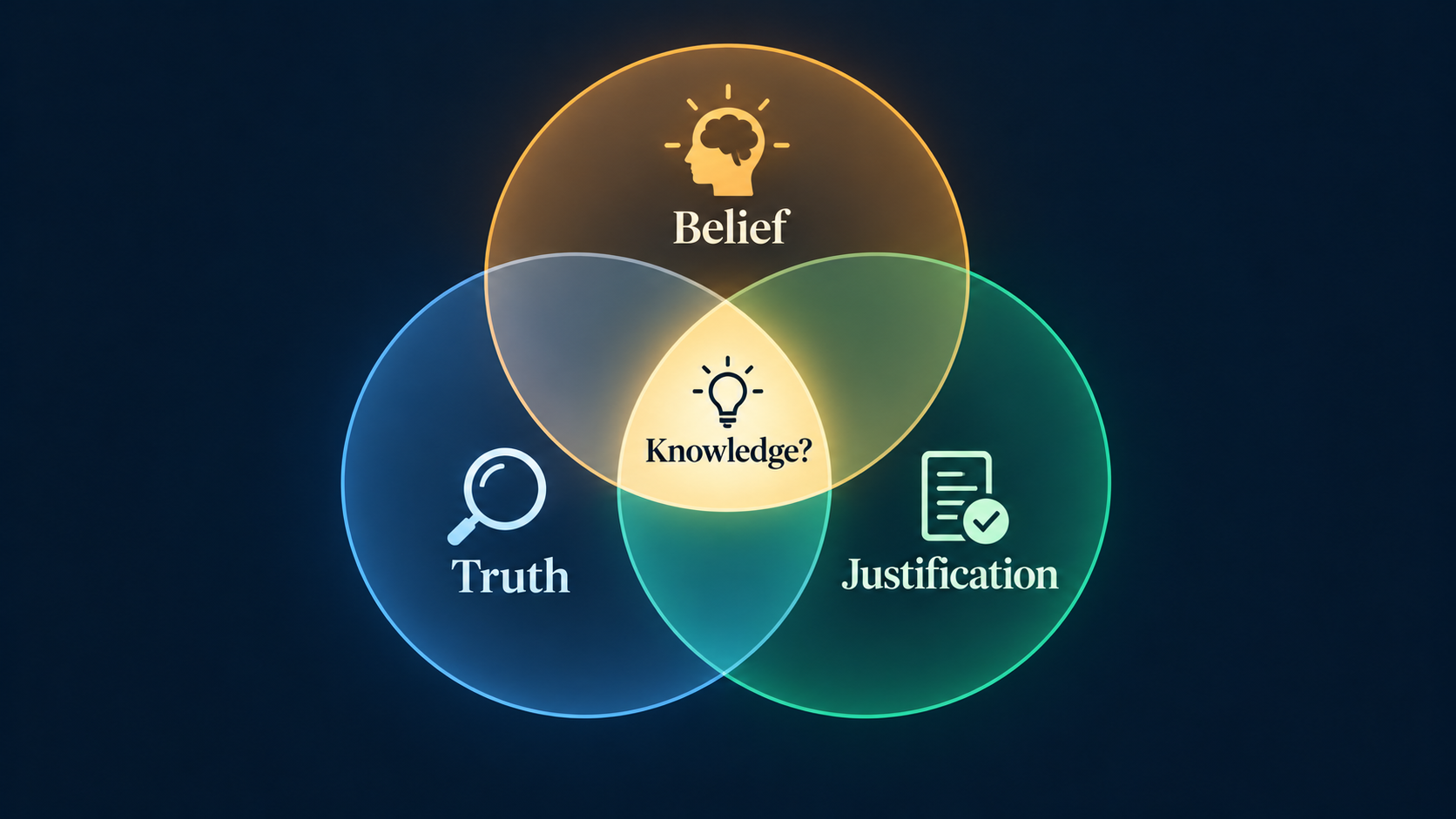
Later philosophers boiled this idea down to three ingredients. Knowledge, on this view, is justified true belief:
Belief: you accept that something is so.
Truth: it really is so.
Justification: you have good reasons for believing it.
Check this against the clock. You believe it’s 3:15, and it’s true. As for justification, you looked at a clock, which is normally a perfectly good reason. So all three boxes are ticked, and still the case feels shaky. We’ll get to why shortly.
Why each ingredient earns its place#
Take them one at a time.
Belief. It sounds strange to say “I know the bridge is safe, but I don’t believe it is.” If you don’t accept something, it’s hard to say you know it.
Truth. You can’t know something false. For centuries many people were sure the Sun circled the Earth. We say they believed it, strongly, rather than knew it, because it wasn’t so.
Justification. Suppose you guess tomorrow’s lottery numbers and happen to be right. You had a true belief, but you didn’t know, because you had no reason behind the guess.
A quick test for yourself: ask “What is my reason for thinking this?” If the honest answer is “I just feel it’s right,” you have a belief, not yet knowledge.
The stopped clock problem#
For a long time, justified true belief looked like a tidy, satisfying definition. Then, in 1963, a philosopher named Edmund Gettier published a very short paper with a long reach, titled “Is Justified True Belief Knowledge?” It presented cases in which someone has all three ingredients and yet doesn’t seem to know.
Our stopped clock is a case of this kind. A similar clock example is often credited to the philosopher Bertrand Russell, who wrote before Gettier. Here is the structure:
You have a good reason (clocks usually work).
Your belief is true (it really is 3:15).
But the truth and your reason have come apart. The clock isn’t showing the time. It’s showing the same hour by coincidence.
The trouble is that your justification is connected to the truth only by accident. Had you glanced a minute earlier or later, you’d have been confidently wrong, using exactly the same reasoning.

How philosophers have tried to fix it#
Many proposals exist. Here are four common directions, in plain language:
No false assumptions. Your reasoning quietly relied on “this clock works,” and that was false. Knowledge shouldn’t rest on a false assumption.
The right connection. The fact itself should be part of why you believe it. Here, the actual time plays no role in why the clock says 3:15.
Reliability. A belief counts as knowledge only if it came from a process that reliably produces truth, and a stopped clock is not that.
Safety. You couldn’t easily have been wrong. With the stopped clock, you easily could have been.
Each idea handles some cases and runs into objections in others. As far as I know, there’s no fix that philosophers generally agree on, and I’d be wary of anyone who says the matter is closed.
Gettier did not show that knowledge is impossible or that “nobody knows anything.” He showed that justified true belief, as a simple recipe, isn’t quite enough. That’s a much more modest and more interesting claim.
How sure do you have to be?#
Another question sits underneath this one: must you be certain to know?
The seventeenth-century philosopher René Descartes tried to find out what could survive total doubt. He imagined that a powerful deceiver might be feeding him false experiences. If that were possible, how could he be sure of anything he saw, including a clock on a wall?
Followed to the end, that kind of doubt leaves very little standing, so many philosophers take a more relaxed view called fallibilism: you can know something even though you could, in principle, be mistaken. Clocks can break. Eyes can mislead. We don’t demand perfect certainty before we’re willing to say “I know it’s 3:15.” We ask for good reasons and a sensible connection to the truth.
Feeling certain is not the same as having reasons. Many persuasive falsehoods work precisely by making us feel sure. Treat your own certainty as something to examine, not as proof.
Knowing that and knowing how#
So far we’ve talked about knowing that something is the case: that it’s 3:15, that Paris is in France. But we also say “I know how to read a clock” or “I know how to ride a bicycle.”
The philosopher Gilbert Ryle drew attention to this difference in his 1949 book The Concept of Mind. Knowing how is a skill. You might read the clock perfectly well without being able to explain the rule you follow, and you can be skilled at something without being able to state any facts about it.
There’s a further layer, too. You know how to use a clock without knowing how the gears inside work. Each layer hides the one beneath it, an idea explored in [Abstraction: The Most Fundamental Idea in Computer Science]. And a step-by-step procedure, the kind discussed in [What Is an Algorithm and Why It Matters], can let you do something correctly without understanding why it works. That’s one reason philosophers separate knowing how, knowing that, and understanding why.
Most of what you know, you borrowed#
There’s an awkward fact about the clock example: very little of what you know comes from checking things yourself.
You didn’t measure the Earth to find out it’s round. You didn’t visit every country on the map. You know most things because someone you have reason to trust told you: a teacher, a book, a reference work, an instrument like that clock. Philosophers call this testimony.
Borrowed knowledge isn’t second-class. But its quality depends on the chain behind it. A clock is a good source when it’s maintained and checked against others, and a poor one when it’s neglected. The same is true of the sources you rely on, and that’s a useful reason to ask not just “what do I believe?” but “who told me, and how would they know?”

A working definition, and what’s still open#
Here’s a modest answer you can carry around. To know something is to believe it, because of good reasons, in a way that is genuinely connected to the truth rather than to luck.
That’s not a precise formula, and I’m not claiming it settles the argument. Some philosophers still defend improved versions of the old definition. Others think knowledge is too basic to be assembled from simpler parts at all. I’ve summarized broad directions here, and if you want to go deeper, the primary texts (Plato’s dialogues, Gettier’s paper, Ryle’s book) are where to start.
Key takeaways#
Epistemology is the study of knowledge: what it is, how we get it, and its limits.
The classic view says knowledge is justified true belief: you believe it, it’s true, and you have good reasons.
The Gettier problem shows that having all three can still be luck, as with the stopped clock.
Proposed fixes (no false assumptions, the right connection, reliability, safety) each help somewhat, and none is universally accepted.
You can know something without being perfectly certain. This view is called fallibilism.
Knowing that, knowing how and understanding why are different things.
Most of what we know comes from trusted sources, so the quality of the chain matters.
One question to take with you: If you can be right by luck and still not know, how many of the things you feel sure about do you actually know, and how would you find out?