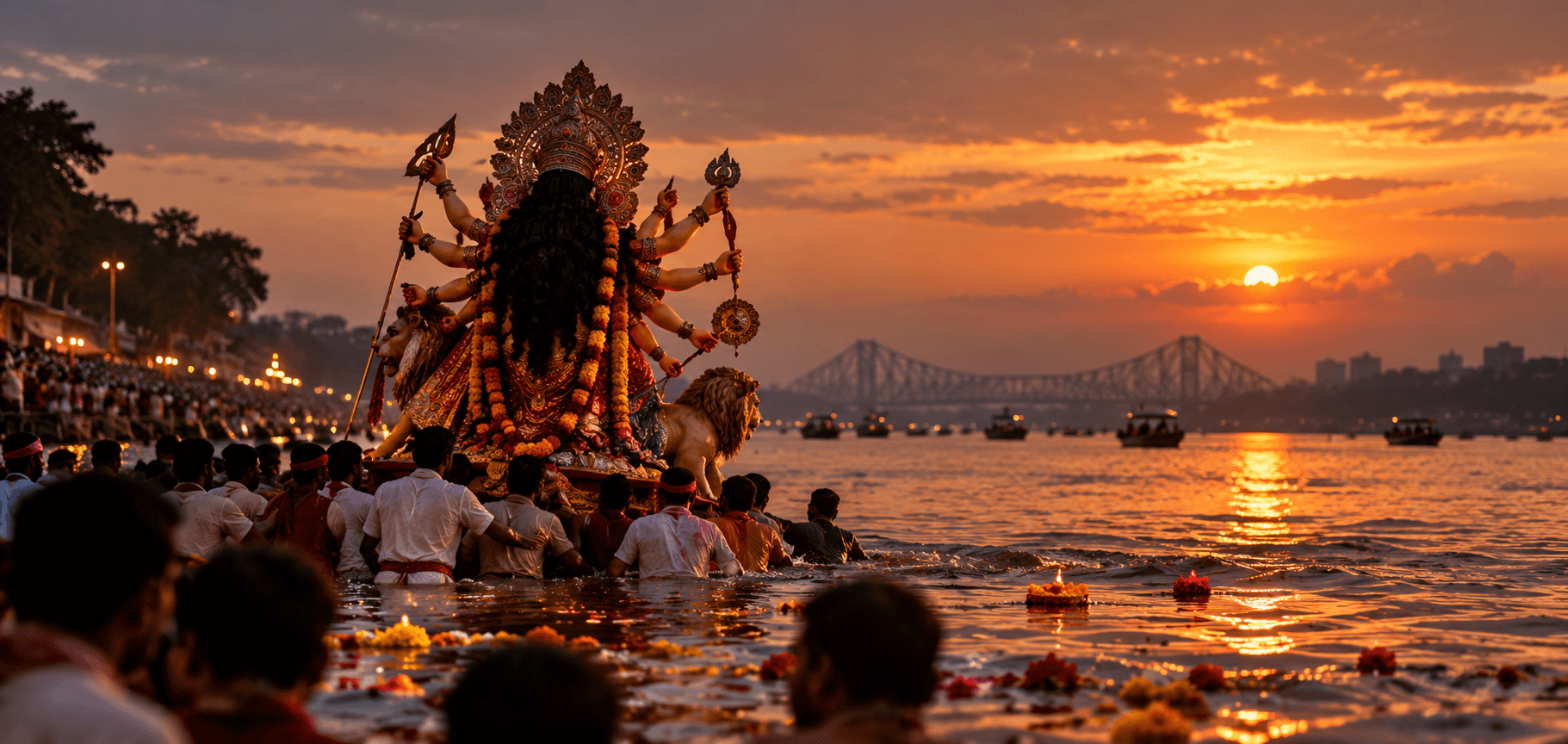

Every year, a neighbourhood spends weeks building a goddess from clay and then gives her to the river. This Bijoya Dashami, we look at why that makes sense, from the mirror ritual to the Moon-based calendar to the river’s side of the story.
Picture a sculptor who spends weeks shaping a ten-armed figure out of river clay. Every fold of the sari, every flicker in the eyes, is just right. A whole neighbourhood gathers to admire it for a few days. Then, on the tenth day, everyone carries it to the river, singing as they go, and lets the water have it.
By any measure of efficiency, this makes no sense. Yet millions of people do exactly this every year, today included, and none of them would change it. Why?
Today is Bijoya Dashami, the last day of Durga Puja in Bengal. Let us use it to understand something that goes beyond one festival: why humans sometimes make beautiful things in order to let them go.
Through this whole post, keep one picture in mind: a daughter’s annual visit to her parents’ home. It will explain more than any theory.
A guest who is also family#
In many Bengali households, the story told is not that a distant deity is being honoured. It is that Durga comes from her husband’s home on Mount Kailash to her parental home on earth, with her children beside her.
That single idea changes the emotional shape of the festival. A victory celebration would end with fireworks. A homecoming ends with a lump in the throat.
The word Bijoya does mean victory, a reference to the goddess’s triumph over the buffalo demon Mahishasura. But walk through any neighbourhood on Dashami and you will notice the mood is not triumphant. It is tender. Everyone knows that every visit home has to end, and that the tenth day is the day she must go back.
The farewell that happens in a mirror#
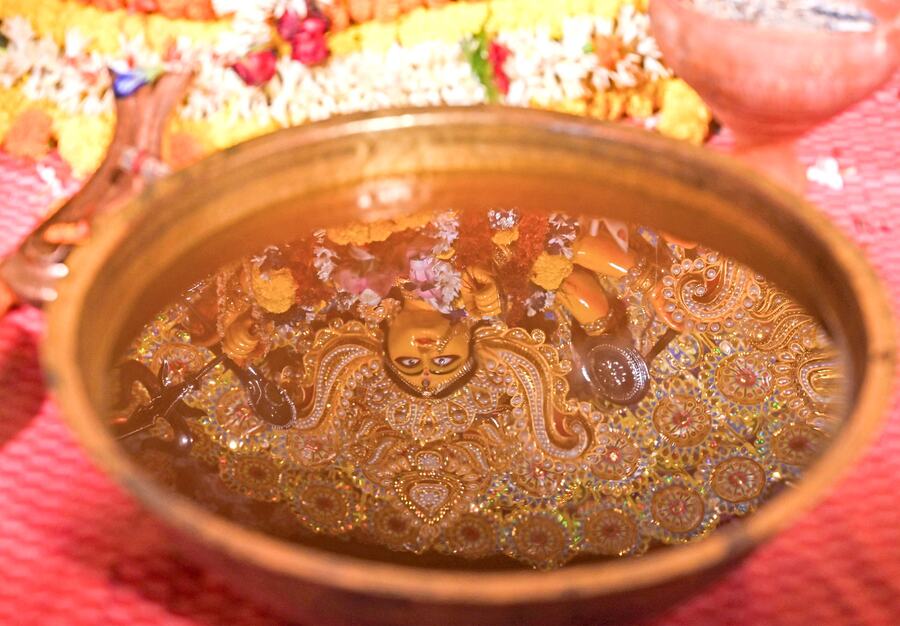
On Dashami morning, after the final puja, comes a ritual called Darpan Bisarjan. A mirror is held before the goddess, and her reflection is offered to water before the idol is taken anywhere near the river.
A priest in Bangladesh describes this as the “real immersion”, because the divinity breathed into the idol at its installation is believed to leave it at this moment. The clay figure that gets carried to the river afterwards has, in that sense, already been vacated.
In several traditions the mirror plays a role earlier too. During the ritual bathing, it is the goddess’s reflection in the mirror that is bathed, not the idol itself.
Key idea: In this ritual logic, the sacred is a presence, not a material. The idol is a vessel. What matters can be invited, honoured and sent off without destroying anything of value.
Think of the last moments before a train leaves, when family stands on the platform and the final look is through the window glass. The reflection is the real goodbye. The idol is the train.
Why the sadness is built into the design#
As the idols leave, the crowd chants a line that sums up the whole day: “Aschhe bochhor abar hobe”, meaning “it will happen again next year.”
Notice the structure. It is a farewell and a promise packed into one sentence. Loss on its own is hard to bear. Loss with a return date is something you can walk home with.
And then the day does something clever. Instead of leaving everyone alone with the sadness, it hands people to one another:
Sindoor Khela: married women apply vermilion to the goddess and then to each other, laughing, hugging, smearing red across faces and saris.
Pranam: younger family members touch the feet of elders to seek blessings.
Visits and sweets: families go to relatives’ and neighbours’ homes to say “Shubho Bijoya” and share sweets such as narkel naru (coconut balls) and nimki. Bengali families abroad often add kolakuli, a sweet that has become a symbol of home.
The ritual converts grief into connection. That is not an accident of tradition. It is what good rituals do: they give a feeling somewhere to go.
If you want to feel Dashami rather than just read about it, send a Bijoya greeting today to someone you have not spoken to in a while. The festival is built for exactly that.
Why Bengal’s Dashami falls on a different day#
Here is a small puzzle. In 2026, much of India marked Dussehra on Tuesday, 20 October. Bengal is keeping Bijoya Dashami on Wednesday, 21 October. Did someone miscount?
No. The answer lies in how the traditional Hindu calendar counts days.
A tithi is not a day in the way a clock defines one. It is the time the Moon takes to gain 12 degrees on the Sun in the sky. Because the Moon’s speed varies, a tithi can last anywhere from roughly 19 to 26 hours, and it starts and ends at odd hours of the day and night.
This year, the Dashami tithi was still running at sunrise on 21 October and continues until about 2:11 PM. Bengal’s own panjika treats the tithi as running into the 21st, so the state’s Dashami holiday, Sindoor Khela and the first immersions fall on that day.
Key idea: A tithi does not respect midnight. Two regions can follow the same Moon and still, honestly, disagree about which calendar day a festival belongs to.
This is a lovely small reminder that “what day is it?” depends on what you choose to count.

The river’s side of the story#
Now the harder part. A festival this large has a footprint.
By one estimate, nearly 30,000 idols are immersed in the Ganga from greater Kolkata after Durga Puja. Environmentalists have long pointed out the pollution this causes in the Hooghly. The problem is not clay as such. It is the materials that do not belong in a river: plaster of Paris, which does not dissolve, and chemical paints.
The response has been practical. Kolkata authorities have used cranes at immersion ghats to lift the remains out of the water quickly, and many puja committees now use non-toxic colours. During the pandemic year, one Kolkata club tried a “green immersion” in a tank, reusing the same water for successive idols once the colour washed off and the clay melted. Such efforts remain a small minority, and officials themselves have said the arrangements at many ghats fall short of Clean Ganga guidelines.
Not every idol is equally gentle on the river. Clay and natural colours return to the water the way the tradition intends. Plaster of Paris and synthetic paints do not.
Here is the interesting part: the ritual’s own logic favours the green choice. If the idol is meant to return to the earth and water it came from, then using materials that actually return is not a modern compromise. It is the tradition done faithfully.
What the clay teaches#
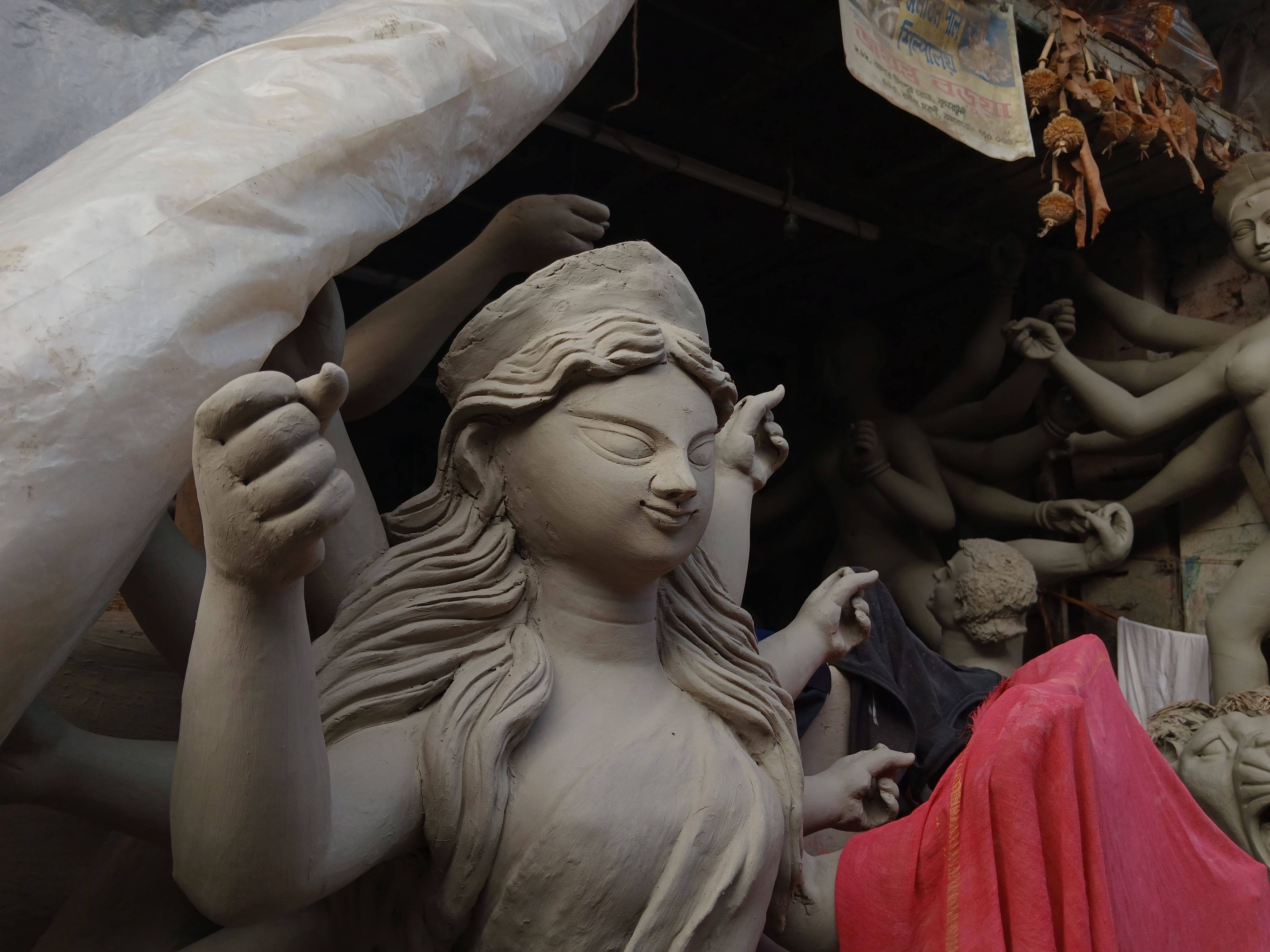
In Kumartuli, the old potters’ quarter of Kolkata, artisans shape the goddess from clay over months. After immersion, the cycle begins again for next year’s puja. Nothing in that loop is wasted, and nothing is kept.
In 2021, UNESCO recognised Durga Puja in Kolkata as part of humanity’s intangible cultural heritage. Notice what that means: what is being protected is not a statue. There are no statues left. What survives is the practice, the knowledge held in hands, songs, recipes and habits of gathering.
Some things are valuable because they end. The impermanence is not a defect to be engineered away. It is what makes people show up, look closely, and say what they mean before the goddess goes home.
Key takeaways#
Bijoya Dashami is built as a homecoming that ends, which explains its bittersweet mood better than the idea of victory alone.
In Darpan Bisarjan, the sacred is treated as a presence that leaves, not a material that is destroyed.
“Aschhe bochhor abar hobe” pairs loss with a promise, and Sindoor Khela, pranam and sweets turn sadness into connection.
Dates differ across India because a tithi follows the Moon, not the clock.
The most faithful form of the tradition is also the kindest to the river: clay and natural colours.
What is something you build carefully every year, knowing it will end, and what does it give you that something permanent never could?