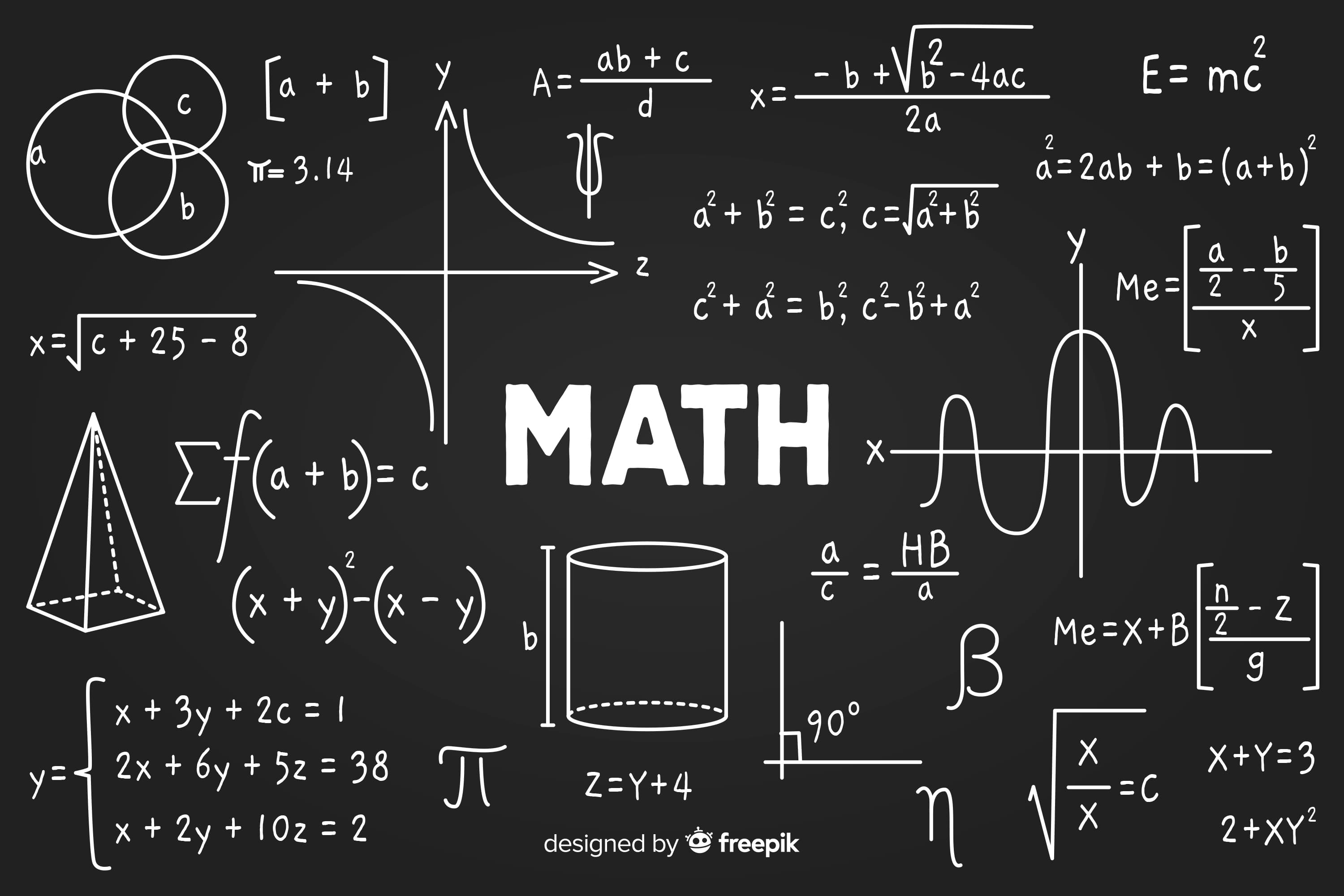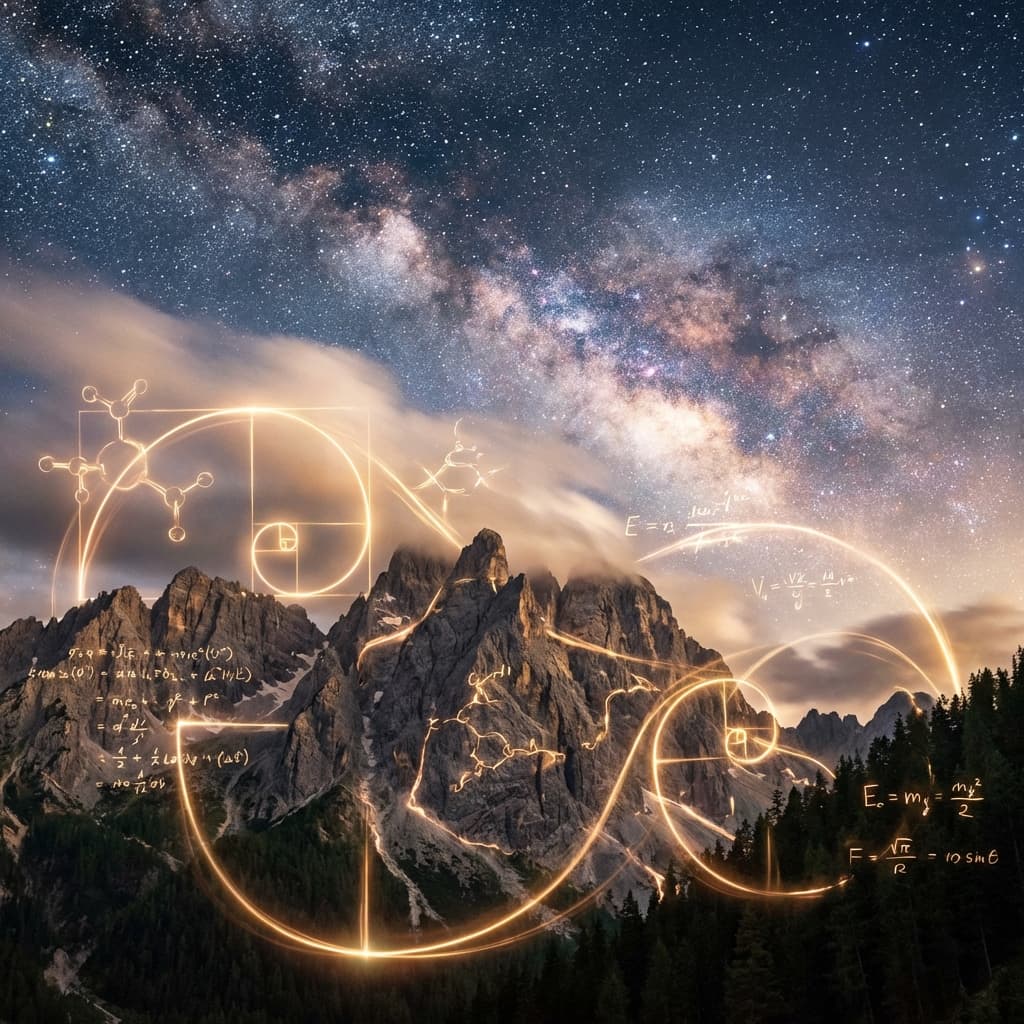

Discover why the universe speaks in equations. From the Fibonacci spirals in sunflowers to Einstein's E=mc², explore how mathematical patterns reveal nature's hidden architecture. This isn't about solving problems—it's about understanding why mathematics describes reality with such breathtaking precision, and what that tells us about the fundamental structure of existence itself.
There's something mysterious about mathematics. Not the kind of mystery you find in a detective novel, but something deeper—the kind that makes you pause and wonder about the nature of reality itself. Why does the universe seem to speak in equations? Why can we predict the motion of planets, the growth of populations, and the behavior of light using nothing more than symbols on paper?
The answer, many would say, is that mathematics is the language of nature. But what does that really mean?
What Makes Mathematics a Language?#
When we call mathematics a language, we're not being metaphorical. Like any language, mathematics is a system of symbols and rules that allows us to describe and communicate ideas. But unlike English or Mandarin, mathematics doesn't describe human culture or emotion. It describes structure, pattern, and relationship—the fundamental architecture of the world around us.
Think about how we use language. When you say "the sky is blue," you're using words to point at something real in the world. Mathematics does the same thing, but instead of pointing at colors or objects, it points at relationships and patterns. When a physicist writes an equation describing how an apple falls from a tree, they're not inventing something arbitrary. They're translating what nature is already doing into a form we can understand and work with.
The remarkable thing is how well this translation works. Mathematics doesn't just approximately describe nature—it describes it with breathtaking precision. This precision is what allowed us to land rovers on Mars, predict eclipses centuries in advance, and design bridges that stand for generations.
The Hidden Numbers in Growth#
Walk through a garden and you'll find mathematics everywhere, often hiding in plain sight. Consider a sunflower. If you count the spirals in its seed head, you'll almost always find numbers from a very specific sequence: 21, 34, 55, or 89. These aren't random. They're consecutive numbers in the Fibonacci sequence:
Each number is the sum of the two before it. Start with 1 and 1, add them to get 2, then 1+2=3, then 2+3=5, and so on. This simple pattern appears throughout nature: in the arrangement of pine cones, the branching of trees, the spiral of a nautilus shell, even in the proportions of the human body.
Why? Because this sequence relates to something called the golden ratio, often written as (phi), which equals approximately 1.618. When you divide any Fibonacci number by the one before it, you get closer and closer to this ratio:
This ratio appears in nature because it represents the most efficient way to pack things in space, to grow while maintaining proportion, to spiral outward without leaving gaps.
From Petals to Galaxies: The Universal Spiral#
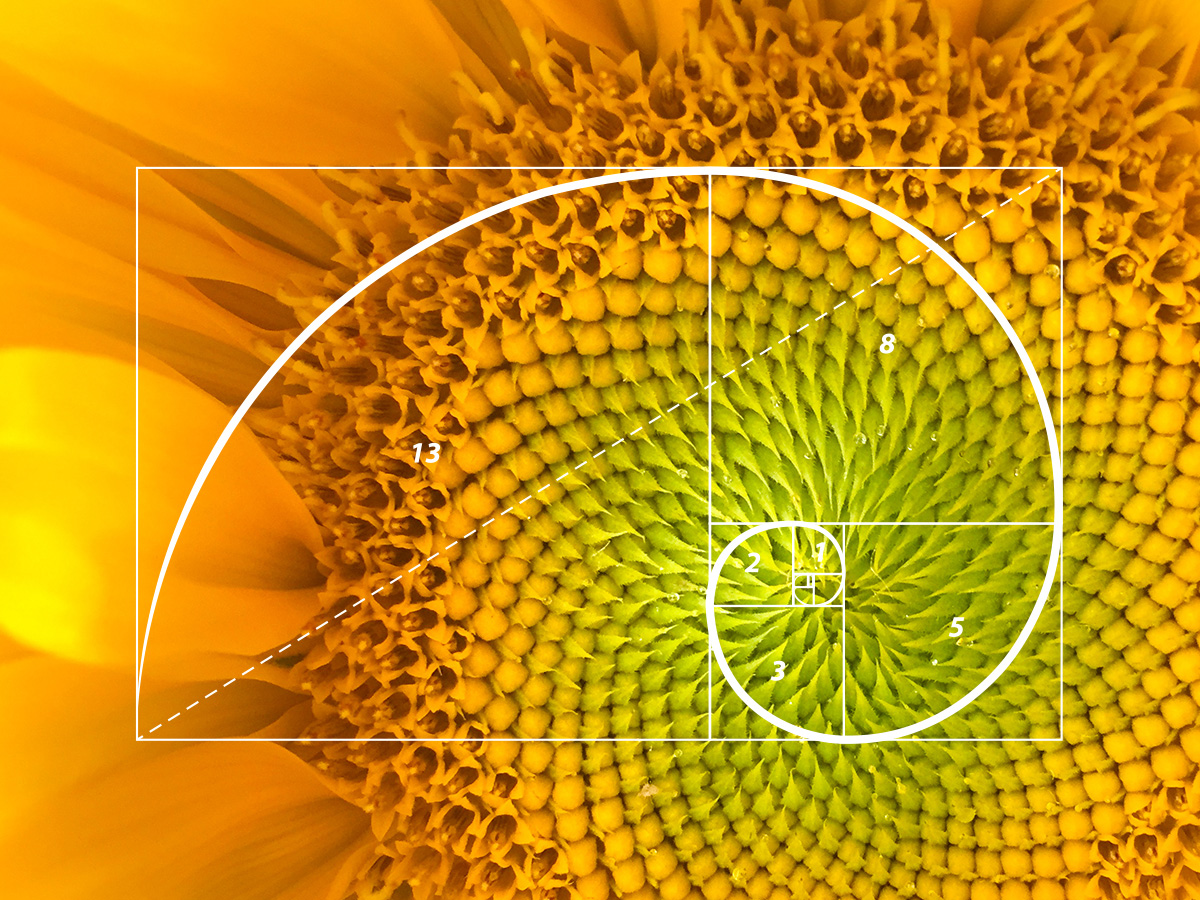
Look closely at the sunflower image above. The spiral pattern isn't random—it follows the golden ratio with mathematical precision. The seeds arrange themselves in two sets of spirals: one clockwise, one counterclockwise. Count them, and you'll find consecutive Fibonacci numbers: typically 21 spirals in one direction and 34 in the other, or 34 and 55, or even 55 and 89 in larger specimens.
Why this specific pattern? Because it's the most efficient packing arrangement possible. Each new seed forms at the golden angle—approximately 137.5 degrees from the previous one. This angle, derived from the golden ratio, ensures that seeds spread out evenly with minimal wasted space. If the angle were different—say, a simple fraction like 90 degrees or 120 degrees—seeds would line up in straight rows, leaving large gaps. But 137.5 degrees is an irrational number, meaning seeds never quite line up, filling the available space with remarkable efficiency.
The sunflower didn't calculate this. Natural selection favored plants whose seeds packed efficiently, and the mathematics of circular growth naturally produces the golden angle. The pattern emerges inevitably from the physics of growth.
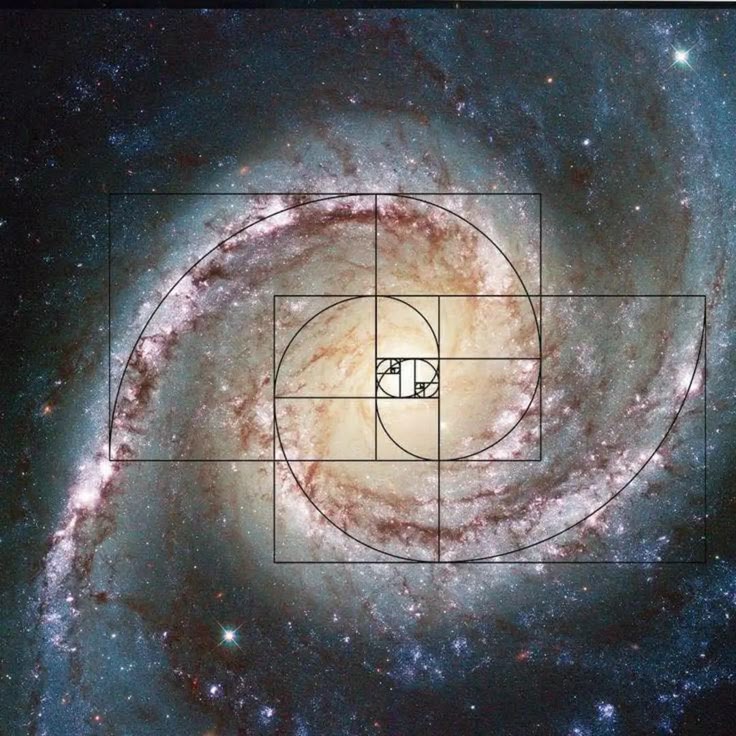
Now scale up from millimeters to light-years. The spiral galaxy above follows the same mathematical principle. The arms of the galaxy trace a logarithmic spiral—the same shape as the nautilus shell, the same proportions as the sunflower. From the microscopic arrangement of flower petals to the cosmic dance of billions of stars, the golden ratio appears again and again.
This isn't coincidence. Spiral patterns emerge whenever something grows outward while rotating—whether it's a flower bud forming new seeds, a mollusk adding material to its shell, or a galaxy's rotation shaping the distribution of stars over billions of years. The mathematics is scale-independent. The same equation that describes how a nautilus shell grows also describes the arms of a spiral galaxy. Change the size by a factor of a trillion, and the mathematical relationship remains identical.
The Geometry of Growth#
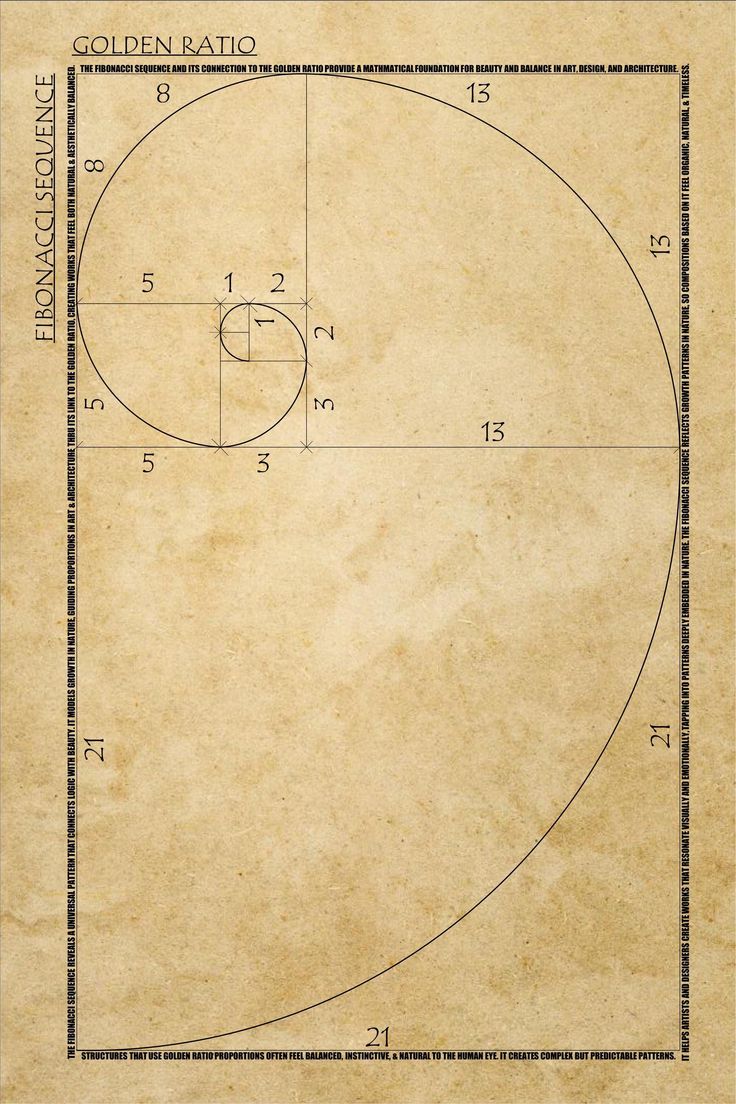
The diagram above reveals how the Fibonacci sequence constructs the golden spiral geometrically. Start with two squares of size 1×1 placed side by side. Add a 2×2 square beside them. Then a 3×3 square, then 5×5, then 8×8, then 13×13, and so on—each square's side length is the next Fibonacci number. Now draw a quarter-circle arc within each square, connecting opposite corners. The result is a smooth spiral curve that expands by the golden ratio with each turn.
This is the same spiral traced by galaxies, hurricanes, nautilus shells, and sunflower seeds. It's called a logarithmic spiral because it maintains the same shape at every scale—zoom in or zoom out, and the proportions remain constant. This self-similarity is why the same mathematical pattern can describe objects from microscopic to cosmic scales.
The spiral appears in nature not because organisms are "trying" to follow mathematics, but because growth following simple rules—add to the previous size, maintain proportion while rotating, expand outward efficiently—automatically produces this pattern. A nautilus doesn't know the golden ratio, but as it grows and adds chambers to its shell, each new chamber must be proportional to accommodate its increasing size. The mathematics isn't imposed from outside; it emerges inevitably from the constraints of growth in a rotating system.
Consider a hurricane viewed from space. As the system rotates and draws energy inward, the spiral arms form according to the same mathematics. Air masses rotating while moving inward create the logarithmic spiral pattern. Or look at the pattern of seeds in a pinecone, the arrangement of leaves around a stem (called phyllotaxis), or even the shape of a ram's horn—all following variations of the golden spiral.
What makes this truly remarkable is that these systems have nothing in common except mathematics. A galaxy is plasma and gravity. A nautilus is calcium carbonate and living tissue. A sunflower is cellulose and biochemistry. A hurricane is water vapor and thermodynamics. Yet they all speak the same mathematical language, forming patterns governed by the same numerical relationships.
The universe didn't need to work this way. We could imagine a reality where different physical laws applied at different scales, where patterns at the atomic level bore no relationship to patterns in galaxies, where growth processes followed arbitrary rules that changed from situation to situation. But that's not the universe we inhabit. We live in a cosmos where the same elegant mathematical principles apply from the smallest seed to the largest galaxy—a universe that, at its foundation, appears to be written in the language of mathematics.
The Mathematics of Motion#
Perhaps nowhere is mathematics more evident than in how things move. Throw a ball, and it follows a parabolic arc. That arc isn't approximate—it's a precise mathematical curve described by a simple equation. If you know the angle and speed at which you threw it, you can predict exactly where it will land.
But the true power of mathematical language becomes clear when we look at gravity. Newton discovered that every object in the universe attracts every other object with a force that follows this relationship:
Let's break this down: F is the force of attraction. m₁ and m₂ are the masses of the two objects. r is the distance between them. G is just a constant number that makes the units work out.
This simple equation—a handful of symbols—describes why apples fall, why the Moon orbits Earth, why planets circle the Sun, why galaxies hold together. The same mathematical relationship governs them all. When we sent Apollo astronauts to the Moon, engineers used this equation to calculate trajectories. It worked with such precision that humans walked on another world.
The equation tells us something profound: gravity gets stronger when objects are more massive, and weaker when they're farther apart. Specifically, it weakens with the square of the distance—double the distance, and gravity becomes one-fourth as strong. This isn't just a pattern we noticed; it's the mathematical structure underlying one of nature's fundamental forces.
Waves and Vibrations#
Drop a pebble in a pond and watch the ripples spread. Those ripples are waves, and waves follow mathematical patterns with remarkable consistency. The basic form of a wave can be described as:
Here, y is the height of the wave at any moment, A is the amplitude (how high the wave gets), f is the frequency (how many waves per second), and t is time. The sine function creates that smooth, repeating up-and-down pattern we recognize as a wave.
This same mathematical structure describes water waves, sound waves, light waves, even the quantum waves that electrons follow. When you hear middle C on a piano, you're hearing air molecules vibrating 261.63 times per second, following this wave equation. The equation doesn't just describe the sound—it is the sound, expressed in mathematical language.
Radio, WiFi, X-rays, visible light—all are electromagnetic waves differing only in their frequency and wavelength. The relationship between them is elegantly simple:
Where c is the speed of light (always the same), λ (lambda) is the wavelength, and f is the frequency. Change one, and the other must change to keep their product constant. This is why radio waves are long and lazy while X-rays are short and energetic. The mathematics constrains what's possible.
Exponential Growth and Decay#
Life itself follows mathematical patterns. When bacteria reproduce, their population doesn't grow by adding the same amount each hour—it grows by multiplying. One cell becomes two, two become four, four become eight. This exponential growth follows the equation:
N(t) is the population at time t, N₀ is the starting population, r is the growth rate, and e is a special number (approximately 2.718) that naturally emerges from continuous growth processes.
This same pattern appears everywhere: in compound interest, in the spread of viruses, in the growth of social networks. It also works in reverse for decay. Radioactive atoms decay exponentially, following the same mathematical form. Carbon-14 dating, which tells us the age of ancient artifacts, relies on this mathematical regularity.
The half-life of carbon-14 is 5,730 years, meaning half of it decays in that time. After another 5,730 years, half of what remains decays. The amount decreases exponentially, following the same equation with a negative growth rate. Nature doesn't deviate from this pattern—the mathematics is absolute.
Energy and Mass#
Einstein revealed perhaps the most famous equation in physics:
Energy equals mass times the speed of light squared. This deceptively simple relationship tells us that mass and energy are interchangeable—two forms of the same thing. The c² term (the speed of light multiplied by itself) is an enormous number, which means a tiny amount of mass contains tremendous energy.
This isn't poetry or philosophy. It's a precise mathematical relationship that explains nuclear reactions, why the Sun shines, and why stars can burn for billions of years. The equation predicted nuclear energy before anyone had created a nuclear reaction. Mathematics saw something in nature that our experiments hadn't yet revealed.
Discovery or Invention?#
This leads to one of the most fascinating questions in philosophy: Are we discovering mathematics or inventing it?
If mathematics is invented, it's a tool we create to make sense of the world—useful, but ultimately a human construction. If it's discovered, then mathematical truths exist independently of us, woven into the structure of reality itself, waiting to be found like continents waiting to be explored.
The fact that mathematics works so unreasonably well suggests discovery. The Fibonacci sequence emerged from a medieval mathematician's puzzle about breeding rabbits, yet it describes sunflowers perfectly. The equation for waves was developed to describe simple pendulums, yet it also describes light. Newton's gravity equation was derived by watching planets, yet it works for galaxies we discovered centuries later.
These equations keep working in contexts their discoverers never imagined. That suggests they're not just human inventions—they're reflections of something real in nature's structure.
The Unreasonable Effectiveness#
The physicist Eugene Wigner famously called it "the unreasonable effectiveness of mathematics." Why should abstract symbols manipulated according to formal rules tell us anything about concrete reality? Why should pure mathematics, developed with no practical application in mind, later turn out to perfectly describe newly discovered physical phenomena?
When Einstein used mathematics to predict that light would bend around the Sun, he was working with equations, not conducting experiments. The equations told him that gravity warps space itself, and light following curved space would appear to bend. Years later, during a solar eclipse, astronomers observed stars near the Sun and found their light bent exactly as Einstein's equations predicted—1.75 arc seconds, matching the mathematical prediction.
How did abstract mathematics know what light would do?
One possibility is that the universe is fundamentally mathematical in nature. Not that it follows mathematics, but that it is mathematics—that beneath the surface of quarks and electrons, of space and time, there are mathematical structures all the way down. Reality isn't just described by math; it's made of it.
Another view is that mathematics works because evolution shaped our minds to recognize patterns. We notice mathematical relationships because creatures that could see patterns—predicting trajectories, understanding proportions, recognizing sequences—survived better than those who couldn't. We're not seeing the universe as it truly is; we're seeing the patterns our minds are built to detect.
Limits and Mysteries#
Yet mathematics doesn't explain everything. It can tell us how gravity works but not why gravity exists. It describes the evolution of the universe but can't tell us why there's something rather than nothing. The equations are silent on consciousness, meaning, and purpose.
There are also places where our mathematical descriptions break down. At the center of black holes, the equations produce infinities—mathematical nonsense that suggests our language isn't quite adequate for extreme conditions. Quantum mechanics and general relativity both work beautifully in their own domains, but they speak different mathematical dialects that we haven't yet unified.
Perhaps mathematics is the language of nature, but we're still learning its grammar. We have the vocabulary for many phenomena, but the complete syntax—the theory of everything—remains elusive.
A Window Into Reality#
Whatever the ultimate explanation, the relationship between mathematics and nature reveals something important about the world we inhabit. We live in a universe of order, not chaos. A universe where patterns repeat, where causes have predictable effects, where the same laws apply everywhere from atoms to galaxies.
This order is what makes science possible. It's what allows us to learn from the past and predict the future. It's why we can send signals to spacecraft billions of miles away and know they'll arrive. The universe is intelligible, and mathematics is the key to that intelligibility.
When you see an equation describing nature, you're seeing more than human cleverness. You're seeing a deep truth about reality—that beneath the complexity and diversity of the natural world, there are simple, elegant patterns that connect everything together. The Fibonacci numbers in a sunflower, the inverse square law of gravity, the wave equation describing light—these aren't different languages. They're all dialects of the same fundamental tongue.
Mathematics doesn't just describe nature. It reveals nature's hidden architecture, the invisible scaffolding upon which the visible world is built. In learning to read this language, we're not just solving problems or making predictions. We're uncovering the fundamental grammar of existence itself.
And that might be the most remarkable thing of all—that the universe is written in a language we can learn to read, speak, and understand. A language where equations become poetry, and poetry reveals truth.
Mathematics and nature—an eternal conversation written in spirals, waves, and starlight. Where have you seen these patterns? What questions does this raise for you? Share your thoughts below, or simply carry this curiosity with you as you notice the equations hiding in everyday life.