A clear, approachable guide to complex numbers: definition and notation, algebraic operations, conjugates, modulus, geometric representation, polar form, De Moivre’s theorem, roots of complex numbers, and practical applications — with worked examples and essential formulas.
Introduction:
Complex numbers from an important extension of the real number system and play a crucial role in higher mathematics and applied sciences. The Italian mathematician Gerolamo Cardano is the first known to have introduced complex numbers. The concept of complex numbers was introduced to provide Solutions to equations such as , Which have no real solutions. Today, complex numbers widely used in mathematics, physies, engineering and computer science.
Definition:
A complex number is an expression of the form where a and b are real numbers, and is an abstract symbol, called "iota".
A complex numben is written in the form: Where a is the real part, denoted as & b is the imaginary part denoted as is an imaginary unit s.t
Example:
Algebraic Operations:
Complex numbers follow well-defined algebraic mules similar to real numbers.
Addition: If and , then :
Subtraction:
Multiplication:
Division: ;
Complex Conjugate:
The conjugate of a complex number is Obtained by changing the sign of the imaginary part.
If , then . 
Absolute Value:
Let a complex number. The non-negative real number is Said to be the absolute value or the modulus of and is denoted by .
Example:
In general, is the distance between the points
Geometrical Representation:
Complex numbers are shown on the Angand plane:
Real pant on the x-axis
Imaginary pant on the Y-axis
Each complex number is represented by a point on the plane.
Polar form of Complex Number:
If P is a point in a complex plain correspoding to the number then we see from the figure that , where is called modulas of and is called the amplitude or argument of , is the angle which makes with positive x-axis.
It follows that, which is called the Polar form of a Complex Number and are called Polar co-ordinates. 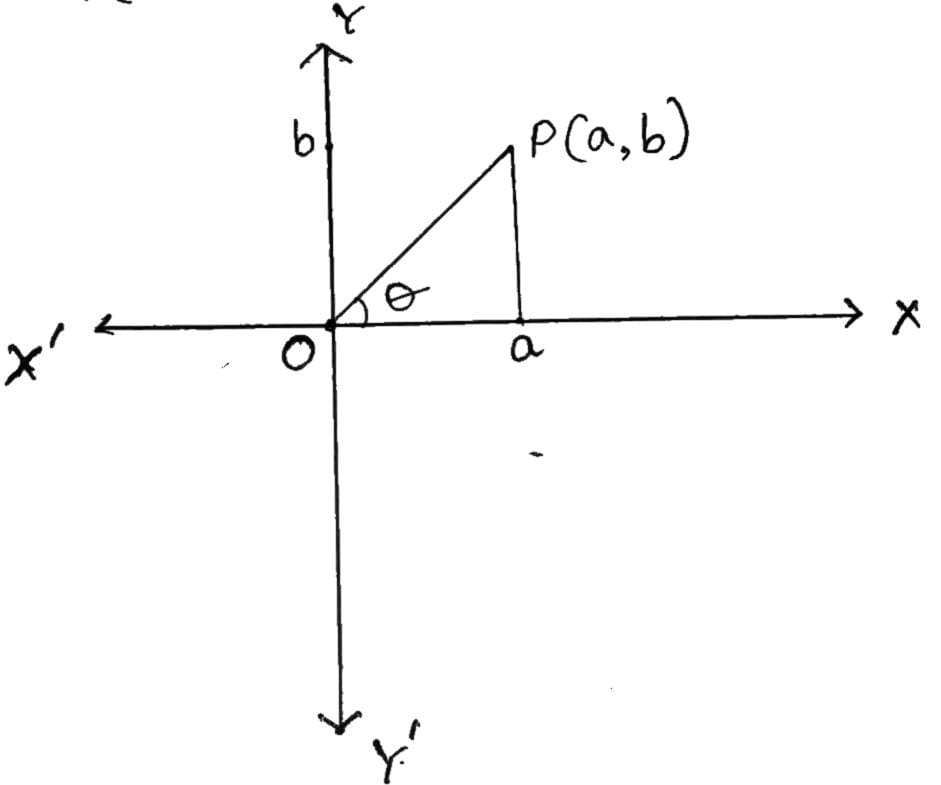
Amplitude of a Complex Number:
Let a complex number. The angle made by the line joining the onigin and the point (a, b) with the positive direction of real axis is called an argument on an amplitude of Z.
Let be the polar co-ordinates of the point (a,b) Such that . Then the general values of the argument will be , where n is an integer, and it will be denoted by Arg z or Amp z, .
De Moivre’s Theorem:
When n is an integer, positive or negative and is a real number,
Root of Complex Number:
The n-th roots of are given by:
Applicationa:
Complex numbers appear throughout applied mathematics and engineering:
Electrical circuits: phasor representation of voltages/currents uses and polar forms.
Signal processing: Fourier transforms and frequency-domain analysis use complex exponentials.
Physics & engineering: wave motion, vibrations, and quantum mechanics employ complex amplitudes.
Advanced mathematics: complex analysis (holomorphic functions), conformal maps, and polynomial theory.
Conclusion:
Complex numbers represent one of the most important extensions of the real number system, transforming mathematical limitations into powerful new possibilities. By introducing the imaginary unit , mathematicians created a framework that unites algebra and geometry in a single, elegant structure. Concepts such as the conjugate, modulus, Argand plane, polar form, and De Moivre’s theorem are not just abstract ideas — they provide practical tools for solving equations, analyzing waves, modeling electrical circuits, and understanding modern physics and engineering systems. Mastery of complex numbers builds a deeper intuition for both mathematical structure and real-world applications. In this way, complex numbers stand as a clear example of how abstract mathematical ideas can lead to concrete technological and scientific progress.

Manisha
editor
"A Math lover, passionate about making tough topics simple and enjoyable for everyone."